
In this article
"Laser lipo" and "VASER lipo" sound alike, and they are often marketed as if they were the same thing. They aren't. Both use energy to prepare fat before it is removed with suction, but the way that energy reaches the fat is completely different, and that difference shows up in your result.
What Both Techniques Try to Do
In traditional liposuction, the surgeon breaks up and removes fat with suction alone. VASER and laser liposuction add a step: they treat the fat first, so it comes out more easily. The question is how much of the fat each one actually treats.
VASER: Energy All Around the Probe
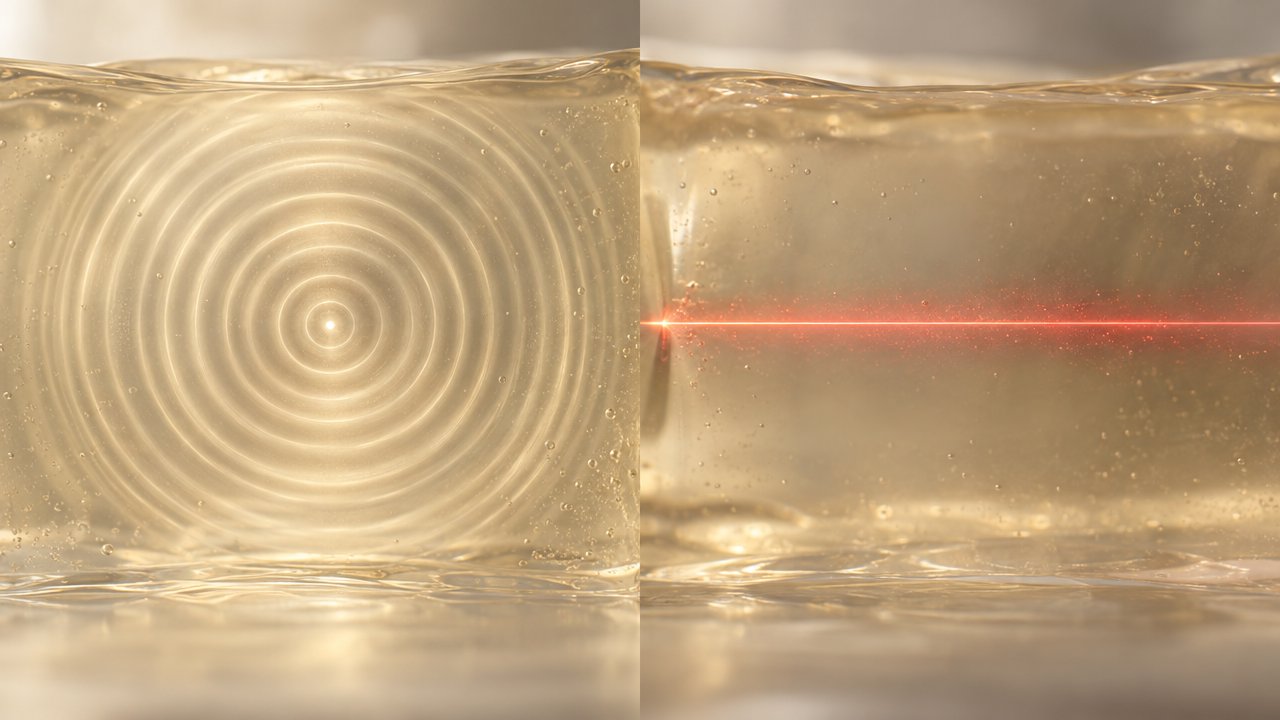
VASER uses ultrasound. Ultrasound spreads out in every direction from the tip of the probe, so it treats the fat all around it, not just in front of it.
The ultrasound works mainly through cavitation. The probe vibrates at 36,000 cycles per second, and those sound waves act on tiny gas bubbles in the fluid placed in the fat before surgery. The bubbles grow until they collapse, which gently separates the fat cells from one another while largely sparing the blood vessels and other tissue around them. The fat softens and turns almost liquid, which lets it be removed more evenly. (This mechanism is described in a 2023 consensus paper on VASER technique: Ruff et al., Plastic and Reconstructive Surgery Global Open.)
Dr. Schwartz has used VASER for more than 20 years. In his hands it consistently makes fat removal smoother and more even. Read more about why it is also gentler in Why Vaser Liposuction Hurts Less Than Traditional Liposuction.
Laser Liposuction: A Narrow Beam
Laser liposuction passes a laser fiber through the fat. A laser beam is narrow and focused, so it heats and destroys only the fat cells directly in its path.
That path is a tiny fraction of the fat that will be suctioned. Most of the fat is never touched by the laser at all, so the extra step adds little to the liposuction itself.
What About Skin Tightening?
The main selling point of laser liposuction is that, used close to the skin, its heat shrinks collagen and tightens the skin.
Heat does shrink collagen briefly. That is the same principle behind radiofrequency and other skin-tightening devices. In Dr. Schwartz's experience, and in the results he has reviewed, the effect is minimal and fades over the first few months.
Why We Use One and Not the Other
At Edition, a procedure has to pass three tests before we offer it: it has to work predictably and consistently, it has to be safe, and it has to be good value for what it delivers. VASER passes. Laser liposuction doesn't add enough benefit to justify its cost, so we don't offer it.
If you're considering liposuction, ask any surgeon what energy they use, how much of the fat it actually treats, and what results they can show you.
Frequently Asked Questions
Is VASER liposuction the same as laser liposuction?
No. Both treat the fat before it is suctioned, but VASER uses ultrasound energy that spreads around the probe, while laser liposuction uses a narrow, focused beam that only affects the fat directly in its path.
Does laser liposuction tighten skin?
That is its main selling point. In Dr. Schwartz's experience and review of results, any tightening is minimal and fades over the first few months, similar to other heat-based devices such as radiofrequency.
Why does Edition use VASER?
VASER softens and liquefies fat evenly around the probe, which lets it be removed more smoothly. Dr. Schwartz has used it for more than 20 years.
Do you offer laser liposuction?
No. It does not meet our standard of working predictably and consistently, and its cost is hard to justify for the limited benefit it adds.
Every surgery carries risks, and results vary from person to person. Your surgeon should explain both before you decide.
Related Procedures
Questions about this procedure? Dr. Schwartz will give you a direct, honest answer at your consultation.
Back to Journal